
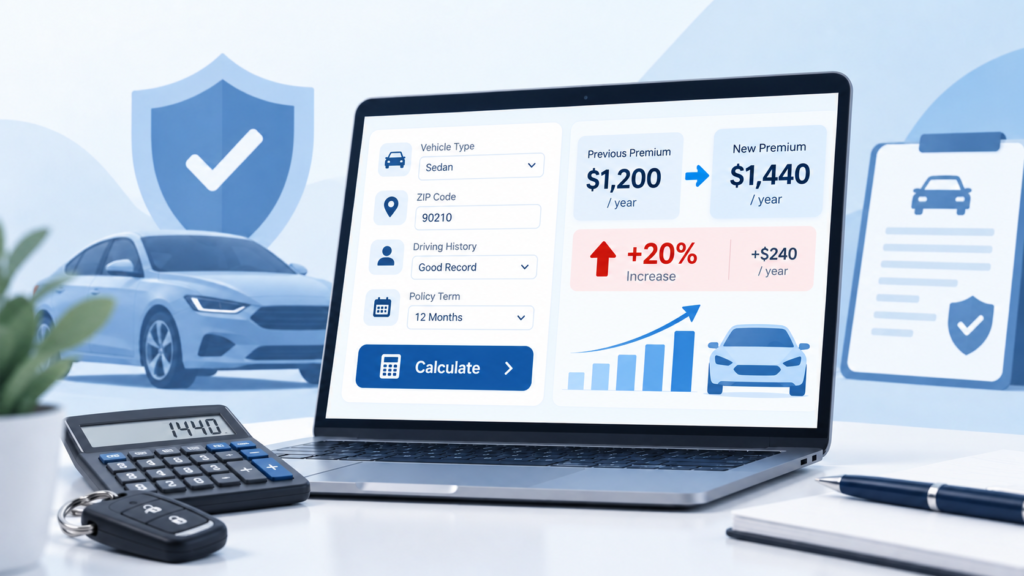
Use our car insurance increase calculator to see how much your premium has changed in dollars and percentage. You can compare monthly, 6-month or annual premiums, even if the old and new amounts cover different periods.
Calculate Your Car Insurance Premium Change
Enter the premium you paid before the change and your new premium. We will normalize both amounts so you can make a like-for-like comparison.
This calculator measures the mathematical change between the premiums you enter. It does not predict future rates or determine why an insurer changed your premium.
How to Use the Car Insurance Increase Calculator
The calculator is designed to work even when your old and new insurance documents show premiums for different time periods.
- Enter your previous premium.
- Select whether that amount covers one month, six months or one year.
- Next, enter your new premium and select the period it covers.
- Click Calculate My Premium Change.
- Finally, review the percentage change and the monthly, 6-month and annual equivalents.
For example, you can compare an old 6-month premium with a new monthly premium. The calculator first converts both amounts to annual equivalents and then compares them fairly.
How Is a Car Insurance Increase Calculated?
The calculation itself is straightforward. First, both premiums are converted to the same annual period. Next, the old annualized premium is subtracted from the new one.
A positive result means your premium increased. In contrast, a negative result means your premium decreased. If both annualized premiums are identical, the result is a 0% change.
Why We Annualize the Premiums First
Comparing $180 per month directly with $1,000 for six months would produce a meaningless percentage. Therefore, the calculator converts both figures to a common annual basis before calculating the change.
As a result, you can compare renewal documents even when the payment or policy periods shown are different.
Car Insurance Increase Example
New premium: $195 per month
The previous annualized premium is $1,800, while the new annualized premium is $2,340. Therefore, the increase is $45 per month, $540 per year, or 30%.
Example With Different Premium Periods
Suppose your previous renewal document shows $900 for six months, while your new bill shows $190 per month.
First, $900 for six months equals $1,800 per year. Meanwhile, $190 per month equals $2,280 per year. Therefore, your annualized premium increased by $480, or approximately 26.7%.
This is why comparing equivalent time periods matters.
Understanding Your Results
Percentage Change
This shows how large the increase or decrease is compared with your previous premium. For example, moving from $100 to $120 is a 20% increase.
Monthly Equivalent
This converts the total difference into an average monthly amount. Therefore, it can make a larger 6-month or annual change easier to understand.
Annualized Premium
This is what each amount represents over 12 months. It allows premiums covering different periods to be compared on the same basis.
Cost per $100
This gives you another simple way to understand the change. For example, $130 means that every $100 of your previous premium has effectively become $130.
What Is the Difference Between an Insurance Rate and a Premium?
The terms rate and premium are often used as if they mean exactly the same thing. However, there is a useful distinction.
An insurance rate is part of the pricing insurers use to calculate coverage. Your premium, on the other hand, is the amount you are charged for your policy after the insurer applies the relevant rating factors, coverage choices and other policy details.
Therefore, this tool is technically a premium change calculator: it compares the insurance amounts you were charged before and after a change.
Why Did My Car Insurance Premium Increase?
A higher premium does not necessarily mean that you caused an accident or filed a claim. Instead, insurers consider many different factors when pricing policies.
Changes Related to You or Your Policy
Your premium may change after a speeding ticket, accident or claim. In addition, adding a driver or vehicle, moving to another location, changing your mileage, losing a discount or changing your coverage can affect what you pay.
Coverage limits and deductibles matter as well. For example, increasing coverage can increase the premium, while a higher deductible may reduce the cost of certain coverages.
Changes That May Be Outside Your Control
Insurance costs can also change because of broader claim trends. For example, higher repair and replacement costs, more expensive claims, theft, severe weather or changing accident patterns in an area can affect insurance pricing.
As a result, a driver with a clean record can still receive a higher renewal premium.
What Should You Check If Your Premium Changed?
Before assuming that the entire difference is a general rate increase, compare your old policy documents with your renewal documents.
- Coverage limits: Check whether liability or other coverage limits changed.
- Deductibles: Compare your collision and comprehensive deductibles.
- Drivers: Look for drivers who were added or removed.
- Vehicles: Make sure you are comparing the same vehicles.
- Discounts: Check whether a safe-driver, multi-policy or other discount changed.
- Address: A change in where the vehicle is primarily kept can affect pricing.
- Policy period: Make sure both premiums cover comparable periods.
- Payment fees: Monthly billing or installment fees can make a payment amount different from the underlying policy premium.
Therefore, the percentage shown by this calculator tells you how much the total premium changed. It does not automatically tell you which individual factor caused the change.
What This Calculator Can and Cannot Tell You
What It Can Calculate
This tool can calculate the percentage difference between two premiums and convert that change into equivalent monthly, 6-month and annual amounts.
In addition, it can compare premiums that were originally quoted for different periods.
What It Cannot Determine
The calculator cannot see your insurance policy, driving record or insurer’s pricing model. Therefore, it cannot identify the exact reason your premium changed.
It also does not predict what you will pay at your next renewal. Instead, it simply analyzes the old and new premium amounts you provide.
Frequently Asked Questions
How Do I Calculate the Percentage Increase in My Car Insurance?
First, subtract the previous premium from the new premium. Next, divide that difference by the previous premium. Finally, multiply the result by 100.
The calculator performs those steps automatically after converting both premiums to equivalent annual amounts.
Can I Compare a Monthly Premium With a 6-Month Premium?
Yes. Unlike a basic percentage calculator, this tool allows the old and new amounts to use different periods.
For example, you can enter your old premium as a 6-month amount and your new premium as a monthly amount. The calculator will annualize both before comparing them.
Can the Calculator Show a Premium Decrease?
Yes. If your new annualized premium is lower than the previous one, the result will show a percentage decrease and how much you are saving per month, per six months and per year.
What If My Coverage Changed at Renewal?
The calculator will still measure the difference between the two premiums. However, the percentage should not be interpreted as a pure insurer rate increase because part of the change may come from different coverage, limits or deductibles.
Why Did My Insurance Go Up Even Though I Had No Accident?
An accident is only one possible factor. For example, changes in repair costs, claims in your area, your vehicle, location, mileage, discounts or an insurer’s broader pricing can also affect premiums.
Should I Enter My Monthly Payment or My Policy Premium?
Whenever possible, use the premium shown on your policy or renewal documents. Monthly payment amounts can sometimes include installment or billing fees.
Therefore, using the underlying policy premium usually produces a cleaner comparison.
Does a 20% Increase Mean I Pay 20% More Every Month?
If the policy structure and payment schedule remain the same, a 20% premium increase generally means the equivalent insurance cost has risen by 20%.
However, your actual monthly bill can differ if payment fees, billing schedules or other charges also changed.
General insurance information on this page has been reviewed against consumer guidance from the National Association of Insurance Commissioners (NAIC) and current 2026 information published by major U.S. insurers. The calculator itself uses only the premium amounts entered by the user and does not rely on estimated insurance-rate data.