
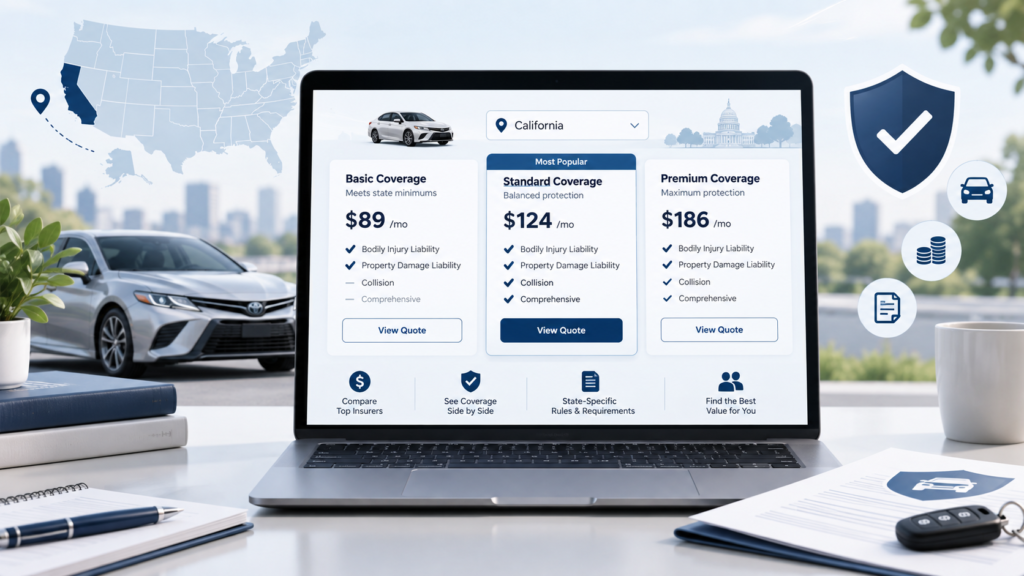
Shopping for auto insurance usually begins and ends with one number: the monthly payment. That figure, by itself, tells you remarkably little. Our car insurance comparison tool fills in everything a price tag leaves out — the limits, deductibles and coverage types that determine what actually happens after a crash.
Requirements are written state by state, so the legal baseline in Ohio looks nothing like the one in New Jersey. Above that baseline, drivers decide how much liability protection to carry and whether to insure their own vehicle through collision and comprehensive coverage. Every one of those choices moves the premium.
Two quotes can appear almost identical on a results page while protecting you very differently. One might pair a $1,000 collision deductible with modest liability limits; the other might halve the deductible and raise the limits considerably. Sorting this out beforehand is what makes the quotes you collect later genuinely comparable.
Below, you will find what belongs in a fair comparison — followed by a tool that shows your state’s rules alongside three common coverage scenarios.
What Should You Compare Before Choosing Car Insurance?
A policy is really a bundle of separate decisions, and each one can be dialled up or down independently. Liability limits sit at the centre of that bundle. They cap what your insurer will pay toward injuries and property damage you cause to other people, and they are usually expressed as two bodily injury figures plus a property damage figure.
Coverage for your own car is a different matter entirely. Collision generally responds when your vehicle hits something or is hit; comprehensive generally handles the other categories of loss, such as theft, hail, fire or striking an animal. Neither is part of liability, and in most states neither is legally required.
Deductibles deserve closer attention than they typically get. Raising a deductible lowers the premium because you have agreed to absorb more of a claim yourself, which matters a great deal on the day you file one. Where your state uses personal injury protection or offers uninsured and underinsured motorist coverage, those elections change the shape of the policy too.
One more layer applies if you do not own the car outright. Lenders and leasing companies set their own insurance conditions through the finance agreement, and those conditions are separate from anything state law requires. Drivers researching the average cost of car insurance often discover that these structural differences, rather than the insurer’s brand, explain most of the gap between two numbers.
Price Is Only One Part of the Comparison
A cheaper premium is not automatically a worse deal, and a costlier one is not automatically better. What a lower price frequently reflects, though, is a narrower policy: reduced liability limits, a larger deductible, or optional coverages quietly left off the quote.
None of that makes the inexpensive option wrong. Plenty of drivers choose leaner coverage deliberately and understand the trade. The problem arises only when someone compares two very different policies as if they were the same product, then picks based on price alone.
How the Car Insurance Comparison Tool Works
The questionnaire runs to five short steps and takes about a minute. You will start by choosing the state where the vehicle is primarily garaged, since that single answer determines which legal requirements apply to you.
Next comes a pair of questions about the driver — an age band and a driving record. Step three asks whether the car is owned outright, financed or leased. Step four covers your current situation, whether you are insured today, buying a first policy, returning after a lapse or adding another driver. The final step asks what matters most to you, with “not sure yet” as a perfectly acceptable answer.
An important distinction: these answers do not calculate a personalized premium, and no figure anywhere in the car insurance comparison tool is derived from them. They control which educational notes appear alongside your results. Every legal figure shown comes from a verified state dataset built into the tool and checked against official state sources — never from your answers.
Once you reach the results, you will see your state’s requirements laid out coverage by coverage, each carrying a verification status. A side-by-side comparison then places three coverage scenarios next to one another. State-specific notes explain any structure that departs from the usual pattern, and contextual notes reflect the answers you gave.
Two further sections round things out. A quote-shopping checklist lists exactly what to hold constant across insurers, and a Sources & Methodology panel names the official source behind each figure, with its verification date. Where a detail in the dataset carries no individual citation, the tool says so plainly rather than implying a source it does not have.
Compare Your Coverage Options
Choose your state below, then work through the five short questions. Your results will show the requirements that apply where you live, a side-by-side view of three common coverage scenarios, and a checklist to take with you when you request real quotes.
No name, no email address and no phone number is required by the comparison tool.
Car Insurance Comparison Tool
Understand your state's minimum requirements, explore coverage scenarios, and learn what to keep identical when requesting quotes.
The comparison tool cannot load. Please try refreshing the page. If the problem persists, contact admin@carpolicylab.com.
| Coverage Type | Per Person | Per Accident | Status |
|---|
Basic Policy
| Coverage Type | Per Person | Per Accident |
|---|
Standard Policy
| Coverage Type | Per Person | Per Accident |
|---|
Michigan PIP Medical Coverage Options
Michigan law allows drivers to choose from several PIP medical coverage levels. Some options require qualifying health coverage.
| Option | Coverage Level | Condition |
|---|
Coverage Elections
Conditional Coverage Requirements
Financial Responsibility Alternatives
This state allows alternatives to purchasing a standard liability insurance policy:
Coverage Comparison Scenarios
These three scenarios illustrate different levels of coverage. None is labeled as “best” or “recommended.” CarPolicyLab does not recommend a coverage scenario; the right choice depends on your own financial situation.
| Coverage |
State Minimum Requirements |
Higher Liability Limits |
Liability + Collision + Comprehensive |
|---|
“Higher Liability Limits” means liability limits above the applicable state minimum. It is a concept rather than a specific number: insurers offer many limit combinations, and the limits available to you are set by the insurer and the policy you choose. Only the state-minimum column shows figures drawn from official state sources. Collision and comprehensive deductible amounts are set when you purchase the policy and vary by insurer.
What Does “Full Coverage” Mean?
“Full coverage” is an informal term rather than a standardized policy type. It commonly refers to liability coverage combined with collision and comprehensive coverage, although actual policy terms and included coverages vary by insurer and policy.
In common usage, the components people mean by the phrase are:
- Liability insurance — pays for injuries and property damage you cause to others in an at-fault accident
- Collision coverage — pays to repair or replace your vehicle after a collision, regardless of fault
- Comprehensive coverage — pays for non-collision damage to your vehicle (theft, hail, vandalism, animal strikes, etc.)
Because the term is informal, a policy described as “full coverage” may still not cover every possible loss. Coverages such as rental-car reimbursement, roadside assistance, gap coverage, and rideshare coverage may or may not be included. Read the policy declarations page to see exactly which coverages, limits, and deductibles apply.
Where a lender or lessor requires collision and comprehensive coverage, any deductible or limit conditions come from your finance or lease agreement rather than from state insurance law. Check that agreement for the specific terms that apply to you.
Quote Comparison Checklist
When requesting quotes from different insurers, keep these items identical across every quote so you are comparing the same coverage:
- Same bodily injury liability limits — per person and per accident
- Same property damage liability limits — per accident
- Same collision deductible — the exact dollar amount on every quote
- Same comprehensive deductible — the exact dollar amount on every quote
- Same drivers — list every driver identically on each quote
- Same vehicles — list every vehicle identically on each quote
- Same optional coverages — added or omitted consistently across quotes
- Same annual mileage assumption — give each insurer the same estimate
- Same policy start date — the same requested effective date on every quote
- Same UM/UIM limits — uninsured and underinsured motorist coverage levels
- Same PIP / MedPay election — where your state offers PIP or medical payments coverage
- Same rental reimbursement — daily limit and maximum days
- Same roadside assistance — included or excluded on each quote
- Same policy term — 6-month vs. 12-month premium periods
Before purchasing, compare each quote’s coverage summary line by line. After the policy is issued, review the declarations page to confirm the coverages, limits and deductibles.
Additional Information for Your State
Sources & Methodology
The requirement figures shown above for this state come from the official sources listed here. Only sources used for the state you selected are shown.
Some state-specific policy details in this dataset do not carry individual source metadata. Confirm these details with the state insurance department before relying on them.
What the verification labels mean
- verified
- Confirmed against the cited official source.
- partial
- Part of the requirement is verified but additional source verification is still needed.
- unverified
- CarPolicyLab could not confidently verify the figure and therefore does not display an unsupported number.
Important Disclaimers
CarPolicyLab.com is an independent informational publisher. It is not an insurance company, insurance agency, broker, or agent and does not sell, quote, bind, or service insurance policies.
The minimum-coverage figures shown are based on publicly available state statutes, regulations, and official department-of-insurance publications. Verification dates are listed with each figure. Laws change; always confirm current requirements with your state’s department of insurance or department of motor vehicles before making coverage decisions.
This tool does not provide legal, financial, or insurance advice. It does not calculate, estimate, or project insurance premiums. The comparison scenarios are educational illustrations, not personalized recommendations. Consult a licensed insurance professional for advice specific to your situation.
The comparison tool does not intentionally store or transmit the answers you enter, and it does not use cookies, localStorage or sessionStorage to save your questionnaire responses.
Understanding the Coverage Options in the Comparison
(H2 — primera sección después de la calculadora. 320 palabras.)
Three scenarios sit side by side in the car insurance comparison tool. They illustrate different coverage levels rather than recommendations, and none is marked as the right choice for you.
State Minimum Requirements
This column reflects the coverage a driver may be required to carry under the rules of the selected state. Requirements vary widely, and the coverage types themselves differ rather than just the dollar amounts. Some states mandate personal injury protection; others require uninsured motorist coverage only to be offered.
Meeting the minimum satisfies the law. Whether it suits any particular driver depends on assets, savings and risk tolerance — which is why this column appears without endorsement.
Higher Liability Limits
Rather than printing a fixed number, this column describes a concept: liability limits set above whatever the applicable state requirement happens to be. No universal figure exists in law, and the combinations available to you depend on the insurer and the policy you select.
The reason to care is straightforward. If you cause a serious accident, your liability coverage pays toward the other party's injuries and property damage up to your limit — and only up to it. Raising that ceiling raises the point at which your own finances become exposed.
Liability + Collision + Comprehensive
Adding collision and comprehensive extends protection to your own vehicle, which liability alone never covers. Collision generally applies to impact damage regardless of fault, while comprehensive handles non-collision losses such as theft, vandalism, weather and animal strikes.
Both typically carry their own deductible, chosen at purchase. This is the broadest of the three scenarios, though broader is not automatically better; an older vehicle worth less than a few years of premiums presents a different calculation than a new one. Our guide to full coverage car insurance explores where that line tends to fall.
What Does Full Coverage Car Insurance Actually Mean?
(H2. 205 palabras.)
Here is a phrase worth handling carefully. “Full coverage” is informal shorthand rather than a standardized policy type you can buy by name, and what it means in practice shifts from one conversation to the next.
Most people use it to describe liability combined with collision and comprehensive. That is a reasonable working definition and probably what an agent means when they say it — but actual policy terms and included coverages still vary by insurer and by policy.
Real policies frequently carry more than those three components. Depending on the state and the choices made at purchase, a policy may also include personal injury protection, medical payments coverage, uninsured and underinsured motorist coverage, rental reimbursement, roadside assistance or gap coverage. Some of these are mandatory in certain states, some are optional everywhere, and several can be declined in writing.
The practical consequence is that the label tells you almost nothing on its own. Two drivers can each describe their policy with the same phrase and hold genuinely different protection. Reading the declarations page — which lists every coverage, limit and deductible in one place — settles the question in a way the shorthand never will.
Why Car Insurance Requirements Differ by State
(H2. 240 palabras. Sin cifras legales — esas viven en el dataset verificado de la calculadora.)
Auto insurance in the United States is regulated primarily at state level. Each legislature and insurance department sets its own rules, which is why no single nationwide minimum exists and why a policy that satisfies one state may fall short in another.
Bodily injury and property damage liability form the common foundation in most places, though the required amounts differ considerably. From there the structures diverge. No-fault states route certain injury claims through the injured person's own policy, typically via personal injury protection, instead of through the at-fault driver's insurer. Other states operate on a traditional fault basis.
Uninsured and underinsured motorist coverage adds another variable. Certain states require it outright; elsewhere insurers must offer it while drivers retain the right to reject it in writing. A handful of states also recognize alternatives to buying a policy altogether, allowing drivers to demonstrate financial responsibility through a deposit, bond or self-insurance certificate.
Several states resist any tidy summary. Michigan, New Jersey and New Hampshire each use structures that cannot be reduced to a single row of minimum limits — one separates a default limit from the lowest a driver may select, another offers two distinct statutory policy types, and the third does not generally require liability insurance of every driver at all. Because these distinctions matter, the tool presents each state's actual figures from its verified dataset rather than repeating a generic national summary here.
Liability, Collision and Comprehensive Coverage Compared
(H2 con tabla. En móvil la tabla se apila en tarjetas; en escritorio es tabla normal.)
The four coverages below account for most of what drivers actually compare. Specific policy wording governs in every case, so treat this as a general orientation rather than a definition of any particular contract.
| Coverage | What it generally covers | Covers your vehicle? | Deductible? |
|---|---|---|---|
| Bodily Injury Liability | Injuries to other people when you are at fault, typically up to a per-person and a per-accident limit | No | Generally no |
| Property Damage Liability | Damage you cause to someone else's vehicle or property, typically up to a per-accident limit | No | Generally no |
| Collision | Damage to your own car from an impact with another vehicle or object, typically regardless of fault | Yes | Typically yes |
| Comprehensive | Non-collision losses such as theft, fire, hail, vandalism or animal strikes, depending on the policy | Yes | Typically yes |
Coverage names, exclusions and conditions differ between insurers. Your declarations page and policy documents are the authoritative record of what you hold.
How to Compare Car Insurance Quotes Correctly
(H2 — sección clave. 375 palabras con el ejemplo.)
Insurance professionals talk about an “apples-to-apples” comparison, and the phrase earns its keep. The idea is simple: change one variable at a time. Hold the coverage identical across every insurer, and the only thing left varying is the price — which is exactly the comparison you wanted.
Let the coverage drift, and the exercise collapses. Suppose one quote comes back at $120 a month and another at $145. Those figures are illustrative only and are not insurance rates. The $25 gap is meaningless until you know whether both carry the same liability limits, the same deductibles and the same list of drivers. Quite often they do not, and the cheaper quote is cheaper precisely because it covers less.
Keep the following identical on every quote you request:
- Bodily injury liability limits
- Property damage liability limits
- Collision deductible
- Comprehensive deductible
- Every driver listed on the policy
- Every vehicle listed on the policy
- Annual mileage estimate
- Requested policy start date
- Uninsured and underinsured motorist limits
- Personal injury protection or medical payments elections, where applicable
- Optional coverages such as rental reimbursement or roadside assistance
- Policy term — a six-month and a twelve-month premium are not interchangeable
Example of an Unequal Insurance Comparison
Illustrative example only — these are not insurance quotes. The figures below were invented to demonstrate a point and do not reflect any insurer's pricing.
| Quote A | Quote B | |
|---|---|---|
| Monthly cost | $118 | $149 |
| Bodily injury liability | $25,000 / $50,000 | $100,000 / $300,000 |
| Property damage liability | $25,000 | $100,000 |
| Collision deductible | $1,500 | $500 |
| Comprehensive deductible | $1,000 | $500 |
Glance at the monthly figures and Quote A wins by $31. Look past them and the two policies are not the same product. Quote B carries substantially higher liability limits and asks for $1,000 less out of pocket on a collision claim.
Which one a driver should pick is not for us to say — that depends on their finances, their assets and how they weigh a lower monthly cost against a larger bill after an accident. What the example does show is that the $31 difference, taken alone, is not evidence of a better deal in either direction. Re-quote both at matching limits and deductibles, and the comparison finally becomes meaningful.
Common Mistakes When Comparing Car Insurance
(H2 con cinco H3. 300 palabras.)
Most comparison errors trace back to a handful of recurring habits. Each is easy to avoid once you know to watch for it.
Comparing Different Liability Limits
This is the single most frequent slip. Insurers do not all default to the same limits when generating a quote, so two results can arrive with different ceilings unless you specified them. Always state your limits explicitly rather than accepting whatever each company proposes.
Ignoring the Deductible
Deductibles move premiums substantially, which makes them a tempting lever — and an easy one to overlook on a summary screen. A quote carrying a $1,500 collision deductible should cost less than one at $500, because you have taken on more of the risk. Confirm the exact figure on every quote before treating the prices as comparable.
Assuming Full Coverage Means Everything Is Covered
Because the term is informal, it promises more than any policy delivers. Gap coverage, rental reimbursement and rideshare use are common examples of things a driver may assume are included when they are not. Ask which coverages are actually listed, then verify against the declarations page.
Looking Only at the Monthly Premium
Payment plans, installment fees and billing frequency all affect the monthly figure without changing the underlying policy. Comparing total policy cost over the same term removes that distortion. Drivers exploring how to lower your car insurance premium often find the largest savings in coverage structure and billing choices rather than in switching companies.
Forgetting State-Specific Requirements
Moving across a state line can change what you are obliged to carry, and a policy that was compliant in your former state may not satisfy the new one. Registration and garaging address both matter here. Checking the requirements for your current state before you shop prevents an unwelcome surprise later.
Why Coverage Limits Matter After a Serious Accident
(H2. 200 palabras. Educativo, sin consejo financiero personalizado.)
Every liability coverage carries a ceiling. Your insurer generally pays covered losses up to the applicable limit, and responsibility for anything above that amount does not simply disappear — it may remain with you, depending on the circumstances and the laws of your state.
Routine fender-benders rarely test those ceilings. Serious collisions can, particularly where injuries require extended treatment or where several people are hurt in a single incident. Medical costs and vehicle values have both climbed over time, and limits chosen years ago may no longer stretch as far as they once did.
That is the practical argument for reviewing your limits periodically rather than renewing on autopilot. How much protection makes sense depends on what you have to protect, and the calculation looks different for a driver with significant savings than for one just starting out. Whether a past claim affects your position is a related question — our explainer on how much insurance increases after an accident covers that ground.
None of the above is financial advice, and CarPolicyLab is not a licensed insurance professional. A licensed agent or adviser in your state can evaluate your specific circumstances.
Car Insurance for Financed and Leased Vehicles
(H2. 145 palabras. Sin inventar deducibles concretos.)
Two separate sets of rules apply when a lender or leasing company has an interest in the vehicle. State law establishes the legal minimum you must carry to drive. Your finance or lease agreement establishes what the institution requires as a condition of the contract, and it may ask for considerably more.
Lenders commonly require collision and comprehensive coverage, since the vehicle secures the loan. Leasing companies typically spell out their insurance conditions directly in the lease. Both may also require that the lienholder or lessor be listed on the policy.
Specific deductible caps and limit requirements vary from one agreement to the next, and we will not guess at yours. Read the insurance clause in your own contract, or ask the lender or leasing company directly, then build your quotes around whatever it actually says.
Frequently Asked Questions About Car Insurance Comparison
(H2 con ocho H3. Sin schema FAQ, tal como pediste.)
Is the CarPolicyLab car insurance comparison tool free?
Yes, entirely. The tool is an educational resource, and there is no fee, no account and no subscription of any kind. CarPolicyLab is an independent informational publisher — not an insurance company, agency, broker or agent — and does not sell, quote, bind or service policies. Nothing in the tool attempts to route you to a particular insurer, because selling insurance is not what this site does.
Does the tool provide real insurance quotes?
No. Real quotes come only from insurers or licensed agents, who price a policy using information the tool never collects. What you get here is different and complementary: your state's legal requirements, a comparison of common coverage scenarios, and a checklist for shopping. Think of it as preparation to do before requesting quotes, so the numbers you receive afterward can be compared fairly.
Do I need to enter personal information?
No. The comparison tool asks for no name, email address, phone number, street address, date of birth, driver's licence number or vehicle identification number. Its questions cover your state, a broad age band, your driving record in general terms, how the vehicle is owned and your current insurance situation. The tool does not intentionally store or transmit your answers, and it does not use cookies, localStorage or sessionStorage to save your responses.
Do all states require the same car insurance?
Not remotely. Insurance is regulated at state level, so both the required coverage types and the required amounts differ across the country. Certain states mandate personal injury protection; others do not. Some require uninsured motorist coverage outright, while others only require that insurers offer it. A few recognize alternatives to buying a policy at all. Select your state in the tool to see the figures and structures that apply where you live.
What is the difference between liability and full coverage?
Liability coverage pays toward injuries and property damage you cause to other people. It does nothing for your own vehicle. “Full coverage” is informal shorthand, usually meaning liability plus collision and comprehensive — the two coverages that respond to damage to your own car. Since the phrase is not a standardized product, always confirm which specific coverages a policy actually contains rather than relying on the label.
Why should I compare the same deductibles?
Because the deductible directly shapes the premium. Accepting a larger deductible transfers more of each claim to you, and the price drops to reflect that. A quote at a $1,500 collision deductible will generally undercut one at $500 from the same insurer — not because it is better value, but because it covers less. Matching deductibles across every quote removes that distortion and lets you see the real price difference.
Should I compare monthly or annual premiums?
Compare the total cost across the same policy term, and confirm whether each quote covers six months or twelve. Monthly figures can mislead, since installment fees and billing frequency alter them without changing the coverage underneath. An insurer offering a paid-in-full discount may look expensive monthly yet cost less annually. Total cost for an identical term is the cleaner basis for comparison.
Do financed and leased cars need different coverage?
Frequently, yes — though the requirement comes from your agreement rather than from state law. Lenders and leasing companies commonly ask for collision and comprehensive coverage because the vehicle secures the loan or lease, and they may require being listed on the policy. Exact conditions differ between agreements, so check the insurance clause in your own paperwork and reflect those terms in every quote you request.
Compare Coverage Before Comparing Prices
Price comparisons only work once the thing being priced is the same. Establish your limits, settle on your deductibles, confirm what your state requires, and account for any condition your lender or leasing company imposes. Every quote you gather after that is measuring one variable instead of several tangled together.
Coverage decisions are personal, and there is no universally correct answer. A driver with substantial savings weighs a high deductible differently than someone for whom an unexpected $1,500 bill would be a genuine problem — both can be reasoning perfectly well and reach opposite conclusions.
Use the car insurance comparison tool above to review your state's rules and compare common coverage options before requesting real quotes. Drivers with a recent violation on record may also want our speeding ticket insurance calculator while preparing to shop.
About this resource. CarPolicyLab is an independent informational publisher. It is not an insurance company, insurance agency, broker or agent, and it does not sell, quote, bind or service insurance policies. This page is educational and does not constitute legal, financial or insurance advice.
State requirement figures shown in the comparison tool are drawn from official state sources and carry a verification date. Laws change, so confirm current requirements with your state's department of insurance or department of motor vehicles before making coverage decisions.